How a Lighthouse campus actually works
A plain-language tour of the six systems that make up a modern hyperscale campus and what makes our design different for each one. Every Lighthouse design decision is guided by our four pillars: affordability, sustainability, environmental protection, and community benefit.
Inside a Lighthouse campus
A modern hyperscale data center campus is six distinct systems, each with major design decisions affecting the community, environment, and grid. The campus includes low-rise buildings, utility yards, access roads, and support spaces. All six systems exist to keep the server rooms running.
 iStock #1372291575 · comp — not licensed
IT halls
Rows of racks holding the computers. Nearly all the digital work happens here, indoors, in controlled space.
Power systems
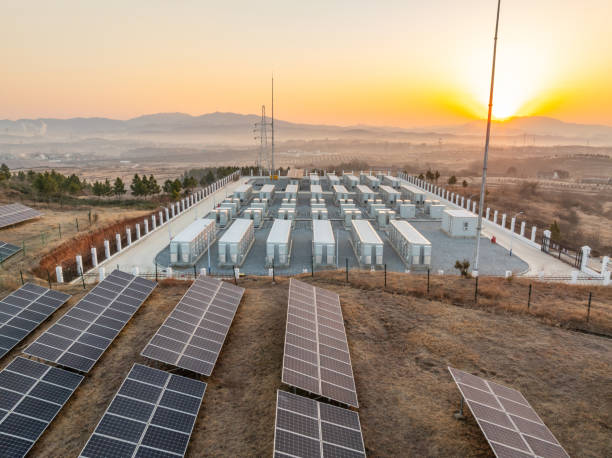
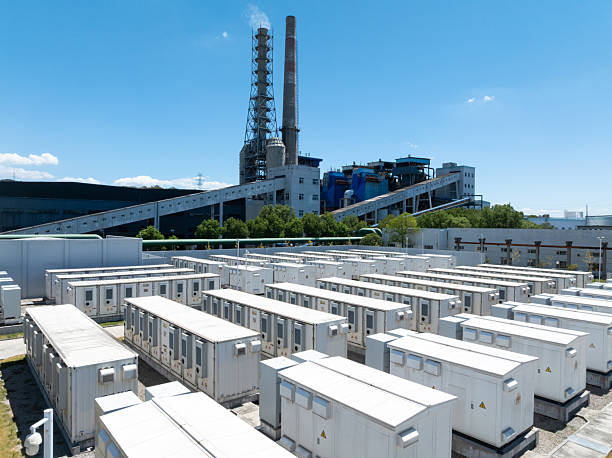
Grid power enters the campus and is stepped down and distributed safely. UPS batteries bridge short interruptions.
Our differenceOn-site BESS batteries (the same batteries used on today’s modern electric grid) replace the need for bulk diesel backup generators. Our data centers never strain the community’s power grid. Backup systems guarantee 24/7 internet function.
Cooling systems
“The giant radiator.”
Our differenceClosed-loop water-cooling uses minimal water around equitable to that of a typical office building. Filled once, circulates indefinitely like a car radiator. Zero discharge, zero aquifer draw. 99% improvement in water usage vs. legacy designs.
Network systems
Network rooms and switches move data between server halls and the outside world. Fiber enters the site through multiple routes so a single cable outage cannot isolate the campus. Most equipment is indoors. The outside footprint is mostly underground conduit and small entry rooms.
Support buildings
Loading, storage, workshops, offices, and security support staffing, spare parts, maintenance, and day-to-day operations. Support buildings create the most direct local employment: maintenance, operations, security, and logistics all typically filled from the local community.
Site infrastructure
Roads, parking, fencing, lighting, landscaping, and stormwater ponds manage traffic, drainage, emergency access, and the site’s edge conditions.
Our commitmentsForested setbacks · Expanded wetlands · Pocket forests · Moss walls · Dark-sky lighting · Stormwater culvert systems · Perimeter trails · Public art where appropriate.
Site selection and feasibility
We build where there is plenty of clean, affordable power, strong fiber connections, and room to keep buildings far from homes. Finding those places, and securing them, is most of our job.
Power availability is now the number one determinant of data center location, and finding the right site requires deep expertise in grid interconnection, fiber, and zoning. Primary markets near fiber-dense coastal cities are grid-constrained; growth is moving to regions where clean power is abundant, affordable, and sustainable. Lighthouse is built for exactly this transition.
- Power availability is number one. Data travels at the speed of light to users regardless of location. For AI model training, power cost and availability matter more than proximity, and primary-market grid constraints are driving secondary-market growth.
- The fiber intelligence challenge. Publicly disclosed fiber maps are not up to date. Accurate routing requires provider NDAs and dedicated study; data centers require 3+ fiber providers with geographically diverse path redundancy; bespoke fiber construction is available but adds 12 to 18 months and $20,000 to $80,000 per route-mile.
- The interconnection bottleneck. The transmission interconnection queue is the industry’s most pressing constraint, and the energy transition magnifies its complexity. Our grid operations and resource planning background is built for navigating it.
 iStock #1780299128 · comp — not licensed
Power that lowers grid costs
Our campuses bring their own clean power and large batteries. The batteries let the campus draw less from the grid at the hours when everyone else needs it most. That protects reliability and helps keep power bills down.
One of the sharpest economic criticism of data centers is cost-shifting: that serving giant new loads raises rates for everyone else. Our sustainable data centers don’t just consume clean energy, they actively improve the grid, lower costs, and reduce emissions for the entire community.
How the design works
- We bring our own capacity and energy. New renewable supply paired with battery storage means the campus adds resources to the system rather than only consuming.
- The campus backs off at the peak. Flexible load design: on-site batteries carry the campus when grid demand is highest, and the campus draws when the grid can easily supply it.
- Higher utilization lowers unit costs. Off-peak draw raises the capacity factor of transmission infrastructure customers already pay for. Fixed costs spread over more sales mean lower per-unit costs: project modeling shows a Lighthouse campus raising grid utilization by roughly 10 percent, lowering grid prices for the surrounding community. The methodology will be published in the Research Library.
- Batteries reduce emissions twice. Grid emissions vary sharply by hour. Storage charges in low-emission hours and discharges into high-emission peaks, reducing net system emissions while reducing system costs.
Rates, stated precisely
Data centers have contributed only a fraction of recent rate increases, and regulators in a growing number of states are moving to require large loads to prove they will not raise rates for others. The fair concern is the future, which is exactly why the campus is engineered not to add strain to the grid at peak hours, and why we build to exceed each jurisdiction’s standards wherever we work.
Carbon accounting, stated precisely
Operations are carbon-neutral on an annual basis: every megawatt-hour consumed is matched annually with new renewable energy supply. Battery operations further reduce the grid’s real hourly emissions. The matching methodology is published in the Research Library, with progress toward hourly matching reported as that market matures.
 iStock #2042546258 · comp — not licensed
 iStock #2235162424 · comp — not licensed
Designed and verified to the property line
The cooling system is sealed, like a car radiator, so it does not use up water. There are no rows of diesel generators. Buildings sit far from homes, behind trees and green barriers, and we measure the sound at the property line to prove it.
Filled once. Recirculated.
Our cooling works like a car radiator: a closed loop absorbs heat from the servers, sheds it through dry coolers, and returns, the same fluid around the same loop, continuously. There is no evaporative tower releasing water to the sky and no continuous draw on wells or municipal supply. After a one-time fill, ongoing water use is comparable to a typical commercial office building.
Dry cooling trades water for a modest amount of additional electricity; that electricity is matched with new renewable supply. And most of the water associated with a conventional data center is consumed not on site but at the thermoelectric plants generating its power. Renewable supply carries far lower water consumption, so the design minimizes both the water you can see and the water you cannot.
 iStock #1187280987 · comp — not licensed
Quiet is an engineering outcome, not just a promise.
The most persistent complaint about data centers is the continuous hum of cooling equipment, and the record shows why walls added after the fact rarely fix it: low-frequency sound bends over barriers. Quiet must be designed from the start. Our approach: no bulk diesel generator yards, closed-loop cooling with no evaporative fans, buildings placed by distance from homes rather than by parcel edge, equipment yards oriented away from residential roads, and forested setbacks and natural barriers as part of the site plan from day one. Screening improves the view; setbacks are what protect the community, which is why buildings are placed by distance first, with barriers as reinforcement. Performance is designed to meet or exceed local noise standards at the property line and verified by boundary testing, with results published.
Increased green space.
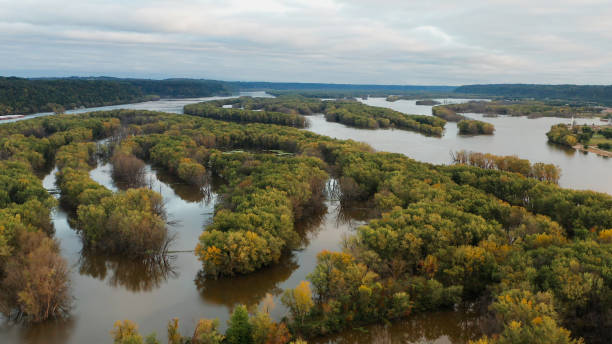
Master-planned sites behind natural barriers, entries that keep traffic off residential streets, conservation easements granted to the community, and preserved and expanded wetlands, pocket forests, and green barriers. Each project site publishes its own site plan showing exactly how these commitments apply on that ground.